The rise: radishes, cookies, and an empire
The experiment was elegant enough to teach forever. 1998: hungry participants sit before fresh-baked cookies; half may eat them, half must resist and eat radishes instead. Then everyone gets unsolvable puzzles. The radish group quits dramatically sooner — and Roy Baumeister's conclusion launched a paradigm: self-control draws on a single limited resource, spent by every act of restraint. "Ego depletion."
The empire grew fast: 600+ studies finding depletion everywhere — resisting emotion drained later persistence, hard choices drained honesty, everything drained everything. A glucose subplot ("willpower is blood sugar") added biochemical glamor. Bestsellers, keynotes, and a decade of productivity advice followed: budget your willpower, schedule hard things early, sip juice before negotiations. As someone trained to read this literature, I'll say plainly: it was a beautiful theory — intuitive, useful-feeling, and apparently buried under evidence. Which is exactly the kind the replication era was built to test.
The fall: what the replications found
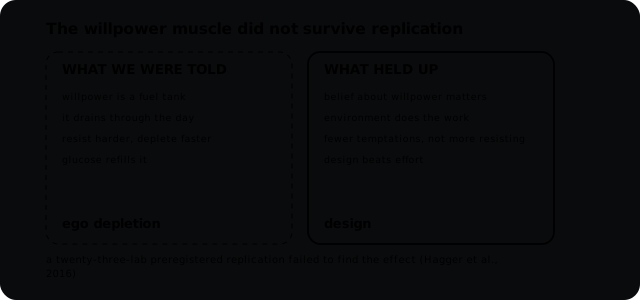
The 2010s audit of psychology reached ego depletion with maximum drama. A bias-correcting meta-analysis (Carter & McCullough, 2014) re-ran the numbers accounting for publication bias — the file-drawer of failed studies that never get published — and found the true effect indistinguishable from zero. Then the field's own gold-standard test: a pre-registered replication across 23 laboratories (Hagger et al., 2016), with a protocol approved in advance by the theory's proponents. Result: effect size approximately nothing. Later large replications agreed. The glucose mechanism had already collapsed under basic arithmetic — the brain's consumption barely changes with self-control tasks, and the original glucose studies didn't survive scrutiny either.
The honest current status: the strong muscle-that-tires model is unproven at best, and the burden of proof has changed hands. The deeper lesson isn't about willpower — it's about how 600 confirmations can orbit an effect that vanishes when the file drawer is opened. Science worked here, slowly and in public. Hold that pattern; wellness will give you many more chances to apply it.
Six hundred studies confirmed a phenomenon that twenty-three pre-registered labs couldn't find. The lesson isn't cynicism — it's that confirmation is cheap and replication is the audit.
What survived the audit
Clearing the rubble matters, because real things stood underneath it:
- Sleep loss impairs self-regulation — robustly. The deprived brain shows amplified amygdala reactivity and weakened prefrontal control; "less willpower when exhausted" is real physiology, no tank required (the sleep-debt file).
- Decision quality degrades with volume. Whatever the mechanism, days of two hundred choices end with worse choices — decision fatigue as a practical phenomenon survives, even as its theoretical engine gets rebuilt.
- Chronic stress taxes regulation. A loaded system has less spare capacity for anything, restraint included (the allostatic account).
- Situation beats trait — by a landslide. The strongest surviving finding in the whole region: people with high "self-control" experience fewer temptations rather than winning more battles, and effortful in-the-moment resistance barely predicts goal attainment. The discipline that works was always upstream.
The strangest finding: belief runs the tank
The subplot that deserves its own headline: Veronika Job, Carol Dweck, and colleagues tested whether beliefs about willpower moderate depletion — and found that only people who believe willpower is limited show the depletion pattern. Non-believers — those who see exertion as energizing or self-renewing — kept performing. Follow-ups extended it: limited-theory believers consumed more sugar, procrastinated more under load, did worse in demanding terms.
Read carefully, this reframes the entire twenty years: the tank may exist mostly where it's installed — a self-fulfilling model, taught by the very books that claimed to describe it. It rhymes with the stress-belief findings: the story you hold about your own capacities is an input to those capacities. Which makes "I only have so much willpower" not a humble confession but a quiet installation — one worth uninstalling on the evidence.
So why do you still collapse at 22:00?
Because your evening never needed a fuel tank to explain it. By 22:00: sleep pressure has been accumulating for sixteen hours and prefrontal control degrades with it; you've made several hundred decisions (real fatigue, whatever its engine); you may be under-fed, over-caffeinated from this morning, and carrying the day's unspent stress; and you're now standing in the highest cue-density environment you own — couch, fridge, phone — at your weakest hour. The collapse is overdetermined. Five causes, none of them a tank, all of them addressable: earlier sleep, decision-batching, real meals, downshift practice, and an evening environment designed by daytime-you (phone in the kitchen remains undefeated). Blaming depleted willpower was always the least actionable diagnosis on the list.
The willpower debate was always a distraction from the agreement: under every theory tested, design beats force. Whether the tank exists, leaks, or was installed by a bestseller — the environment-first, pre-decided, identity-backed life outperforms the white-knuckled one in every dataset. Build for the version of you that needs no heroics, and the heroics question retires itself.
What to build instead
- Environment first. Friction on what you want less of, ease on what you want more of — the 20-second architecture. This lever survived every replication because it never depended on the theory.
- Pre-decide everything recurring. If-then plans and stacks — the implementation-intention literature (which replicates well) shows calm-you's decisions roughly doubling follow-through over moment-you's resolve.
- Protect the substrate. Sleep, food regularity, stress recovery — the genuine impairers of self-regulation. Most "weak willpower" is a tired brain being asked to referee a rigged game.
- Install identity, not restraint. "I don't" beats "I can't" in the data; non-smokers don't resist cigarettes. The votes-and-evidence method builds selves that need no tank.
- Keep willpower as the emergency brake. It exists, it works in moments, and moments are its job. An engine it never was — and the twenty-year detour through the muscle metaphor mostly proved how much better the car runs when nobody's relying on the brake to move it.
Stop budgeting a resource. Start designing a system.
Seven questions, about a minute. See where your architecture leaks — and which design fix replaces the most willpower.
Take the Free Assessment →Frequently asked questions
Is willpower really a limited resource?
The strong fuel-tank model failed its major pre-registered replications and bias-corrected meta-analyses; the glucose mechanism collapsed earlier. What's real: sleep loss, stress, and decision volume genuinely impair self-regulation.
What was the ego depletion theory?
Baumeister's model: self-control as a single drainable resource — radish-resisters quitting puzzles sooner. 600+ supporting studies, then a 23-lab replication finding approximately zero.
If willpower isn't limited, why do I give in at night?
Overdetermination: sleep pressure, real decision fatigue, under-eating, unspent stress, and maximum cue density at your weakest hour — five addressable causes, no tank required. Belief matters too: only limited-willpower believers show the depletion pattern.
What should I rely on instead of willpower?
The design hierarchy: environment (friction/ease), pre-decisions (if-then, stacks), substrate (sleep, food, recovery), identity ("I don't"). Willpower stays as the emergency brake it always was.