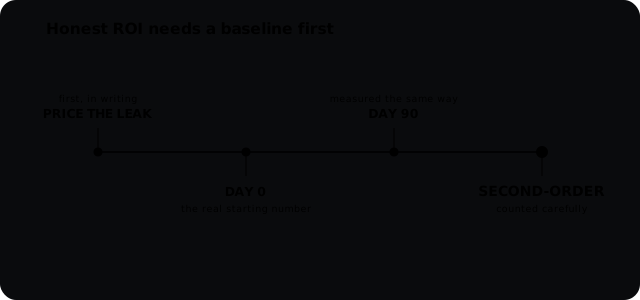
Multiples without denominators
The AI sales conversation has developed a verbal tic: the multiple. Five-x ROI. Ten-x productivity. Pays for itself in weeks. Ask the obvious question — five times what, measured how, at your volumes? — and the conversation gets aspirational fast, because the honest answer is that nobody measured anything: the multiple is a vibe with a number attached, borrowed from a case study whose denominator also never existed.
This matters beyond hygiene because the genuine article exists. Well-targeted automation against a real, priced leak routinely produces returns that need no inflation — which is exactly why the inflation offends. We refuse to promise multiples for the same reason a doctor refuses to promise outcomes before the bloodwork: the number isn't knowable before the measurement, and anyone quoting it anyway is telling you about their marketing, not your business. What follows is the method that replaces the vibe — the one we run, and the one to demand from anyone you let near your operations.
The day-zero page: where ROI is actually decided
ROI is decided before anything is built, on one page, by measuring the current state of the one workflow being automated:
- The leak, priced: missed calls × share that were new business × average value (the phone math); leads × current response time × the documented decay (the 5-minute window); no-shows × slot value; invoices × average days late.
- The hours, counted: who spends how long weekly on this workflow's manual layer — the Tuesday-audit data, workflow-scoped.
- The quality state: error rates, complaint frequency, the re-work loop.
- The date. Signed, agreed, filed. This page is the project's birth certificate and — ninety days later — its verdict sheet.
Two things happen on this page. First, the ROI question becomes answerable before a euro is spent: a leak priced at $4K/month against a build priced at $X is arithmetic anyone can check. Second — and this is the part vendors who skip baselines understand perfectly — some projects die here, because the leak turns out to be small, and an honest audit says so. Ours do; that's the policy: if the audit doesn't show a clear return, we don't build. The page protects both sides, which is why only one side ever resists it.
ROI isn't produced by the build. It's produced by the targeting — and targeting is a measurement activity that happens, or doesn't, before anyone opens a laptop.
Counting the value (conservatively)
The day-90 value side, with the discipline that keeps it honest:
- Recovered revenue — the directly attributable kind: after-hours inquiries that became bookings, reminder-rescued no-show slots refilled, leads answered in-window that converted. Attribute conservatively; the number survives scrutiny better small and real than large and arguable.
- Recovered hours — priced at their redeployment, not their existence. The strictest rule in the method: ten freed hours filled with growth work, service quality, or genuine recovery count at full value; ten freed hours that evaporated into the inbox count at zero. (This rule alone separates honest accounting from theater — and it's why the roadmap names a destination for recovered hours before the build.)
- Error and friction reduction — re-work eliminated, transposed-digit incidents, the complaint category that disappeared.
- Second-order effects, counted carefully: response speed lifting close rates, freed humans lifting retention, founder hours returning to the only-founder work. Real, often the largest line eventually — and the easiest to inflate, so they enter the ledger labeled as estimates, never as proof.
Counting the costs (all of them)
The side the case studies trim: build or subscription, integration work, your own and your team's hours on setup, training, and shadow-mode correction (founders unprice their time here with the same reflex as everywhere else), maintenance when your processes change (they will), weekly monitoring — someone reading outputs and transcripts, which is a standing cost because unread systems decay — and the learning-period errors, honestly logged. A system that clears this ledger is genuinely paying. Most well-targeted ones do — comfortably — which is the quiet proof that the dishonest version was always unnecessary: real returns survive real accounting.
The day-90 verdict
Same metrics, same method, ninety days later, against the day-zero page. Three honest outcomes: a measured win — the delta clears the costs; scale it, and take the next workflow with the same discipline. A fixable shortfall — the weekly reviews usually show exactly where (a mis-tuned handoff, an unintegrated edge case); fix and re-measure at day 120. A miss — rare under audit-first targeting, and when it happens, the honest move is the one that builds decade-trust: name it, kill or rebuild it, and let the day-zero page take the credit for making the miss visible — because the alternative wasn't success; it was an invisible miss billing monthly forever.
Then keep the loop: ROI measured quarterly, per workflow, on one page. The businesses that do this build automation portfolios where every line item has receipts — and budget conversations that take eleven minutes.
Stop asking vendors "what ROI will this deliver?" — they don't know, and the confident ones are the ones to leave. Ask instead: "what will we measure before you build, and what happens if the audit says don't?" The first question buys a multiple. The second buys a method — and the method is the thing that actually pays.
Reading vendors by their arithmetic
The whole vendor market, sorted by one behavior: where does measurement sit in their process? Multiples in the pitch deck, baselines never mentioned → marketing with an invoice. Detailed questions about your volumes, values, and current state before any price → a builder pricing a project. Willingness to put the kill-condition in writing — if the audit doesn't justify it, we walk → the incentive structure actually pointed at your outcome. It's the same tell as everywhere in this series (the demo test, the failure taxonomy): the honest operators are recognizable by what they insist on knowing before they'll take your money. Use it.
Start with the page that decides everything.
The audit prices your leaks and hours before anything is built — and if it doesn't show a clear return, we don't build. That's the policy, in writing.
Get your Agent Blueprint →Frequently asked questions
How do you calculate ROI on AI automation?
Delta against a documented baseline: measure the workflow's day-zero state (hours, response times, priced leaks), build, re-measure at day 90, subtract full costs. No day-zero page, no provable ROI — ever.
Why shouldn't I trust promised ROI multiples?
A multiple before measurement is arithmetic without inputs — the same automation is worth six figures or nothing depending on your volumes. Vendors who quote before asking are pricing their marketing.
What returns does AI automation actually deliver?
Against real leaks: recovered revenue (windows caught, no-shows cut), redeployed hours, error reduction, and carefully-counted second-order effects. The range is wide — and decided by targeting, before the build.
What costs should I include?
All of them: build, integration, your own hours, maintenance, weekly monitoring, learning-period errors — and count recovered hours only at the value of what actually fills them. Real returns survive real accounting.