The pill that would outsell everything
Run the thought experiment. A new compound shows effects on depression comparable to first-line treatments in umbrella reviews, reduces anxiety acutely within a single dose, improves sleep, sharpens cognition, cuts all-cause mortality, costs nothing, and has side effects people pay gyms for. The launch would be the biggest in pharmaceutical history; the waiting lists would crash websites.
The compound exists. The delivery mechanism is your legs. And the reason it goes underprescribed isn't conspiracy — it's that "exercise helps" gets handed over with no dose, no protocol, no acknowledgment of the cruel catch-22 (the condition suppresses the exact resource the treatment seems to require), and wrapped in a fitness culture whose minimum bar — the program, the gym, the transformation — is exactly what a depleted nervous system cannot clear. A decade of this work work taught me the gap was never evidence. It was prescription — and prescription is fixable in one article.
The evidence, sized honestly
The landmark is the 2024 BMJ umbrella review (Noetel et al.): across hundreds of trials, exercise produced effects on depression comparable to — in some comparisons exceeding — psychotherapy and antidepressants for mild-to-moderate cases, with walking, jogging, yoga, and strength training all performing, and some dose-response favoring intensity. For anxiety, meta-analyses show moderate effects, with single sessions producing measurable acute reductions — the state shifts within the hour.
The honest asterisks, because this site doesn't sell: exercise trials can't be blinded (you know if you ran), most are short, and severe depression needs professional care — medication and therapy remain essential there, with movement as adjunct rather than replacement. The defensible, still-remarkable claim: for the enormous mild-to-moderate middle, movement is a first-line-adjacent treatment with a side-effect profile other treatments dream about — and it stacks with all of them.
Why it works: five mechanisms
- It spends the stress chemistry as designed. Anxiety and chronic stress are mobilization — fuel and hormones dumped for emergencies that never become physical. Movement is the emergency arriving: the chemistry gets metabolized, and the system completes the cycle it was built around (the recovery half, finally run).
- It fertilizes the hardware. Exercise reliably elevates BDNF — the growth factor that supports neuroplasticity — and chronic depression tracks with suppressed plasticity. Movement re-opens the change window that therapy and habit work then write into.
- It's exposure therapy for arousal. A racing heart and fast breath, produced voluntarily and survived weekly, teaches the brain those sensations aren't emergencies — directly defusing the body-writes-the-story loop where anxiety reads its own symptoms as threats.
- It repairs the sleep that repairs everything else. Regular movers fall asleep faster and sleep deeper — and since sleep is the amplifier setting on mood, half of exercise's mental-health effect may simply be routed through the night.
- It casts identity votes. Every session is evidence: someone who does hard things voluntarily, someone whose actions move their state. For a condition whose core lie is helplessness, that accumulating proof — agency with receipts — is its own therapeutic ingredient.
Movement isn't one treatment. It's five mechanisms in a trench coat — chemistry, plasticity, exposure, sleep, and identity — billing as a walk.
The dose: minutes, not programs
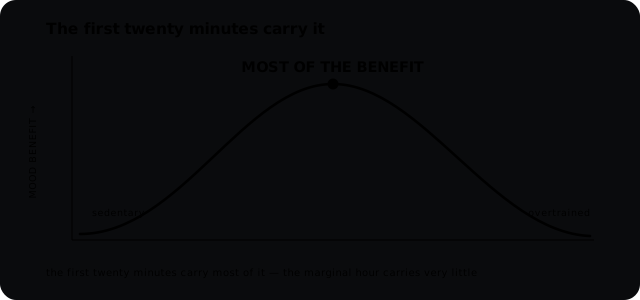
Fitness culture set the entry bar at programs; the mental-health data sets it at minutes. The dose-response curve is steepest at the bottom: trials show mood lifts from 10-minute walks; the famous 1.2-million-person analysis (Chekroud, Lancet Psychiatry) found the lowest mental-health burden around 3–5 sessions of ~45 minutes weekly — with substantial benefit far below that, and downsides only at extreme volumes. Going from nothing to something captures more than going from something to everything.
The practical prescription, written like one: brisk walking, 10+ minutes, most days, outdoors when possible (daylight stacks the circadian benefit for free); two strength sessions weekly as capacity grows — the meta-analyses on resistance training and depression are solid, and the underrated identity dividend ("I lift") compounds; build toward the 3–5 session zone if and when it feels like appetite rather than penance. Nothing about transformation. Everything about repetition.
The anxiety caveat
One honest fork for anxious systems: intense exercise produces anxiety's physical signature — pounding heart, breathlessness, heat — and for panic-prone people, early hard sessions can read as attacks and backfire into avoidance. The fix is sequencing, not exclusion: start rhythmic and moderate — walking, swimming, cycling, where breath stays conversational — and let the system rebuild trust in arousal gradually. Intensity then becomes what it actually is, deliberate exposure, added on purpose later. (Wired-profile people get the same advice for the same reason: match the tool to the direction of the break — a revving system needs movement that spends, not movement that spikes.)
Starting when you can't
The catch-22 deserves a real answer: depression suppresses motivation, energy, and the belief that anything will help — the exact resources the gym-bag plan requires. The clinical workaround is behavioral activation's core move: invert the order — action first, mood follows.
- Shrink below the resistance threshold. Five minutes counts fully. On the worst days, shoes-on-and-outside-the-door counts — the floor principle applied to a clinical context, where it was born.
- Anchor it, don't schedule it. "After my morning coffee, I walk to the corner" — the existing habit carries the new one when willpower can't (stacking mechanics).
- Recruit one human. The walking appointment survives feelings that the solo plan doesn't — and the co-regulation is its own dose.
- Track attendance, never performance. Distance, pace, and progress photos are for later (or never). A chain of did-it marks is the only honest metric for this phase, and the chain itself starts paying.
- Let the spiral run upward. Each micro-dose lifts state slightly; the lift funds the next dose. The mechanism that trapped you — mood and behavior feeding each other — runs in both directions. You're not waiting to feel better to move. You're moving in doses small enough to be possible, and letting the feeling follow the feet.
Stop filing exercise under fitness and file it where the evidence puts it: state medicine, dosed in minutes. The body was never the only thing training. The ten-minute walk is a prescription — and the steepest part of the entire dose curve is the step out the door.
Find your starting dose.
Seven questions, about a minute. See what your system needs first — movement, sleep, downshift — and the floor it can actually clear.
Take the Free Assessment →Frequently asked questions
Is exercise really as effective as antidepressants?
For mild-to-moderate depression, the BMJ umbrella review found comparable effects — walking, jogging, yoga, and strength all working. Severe depression needs professional care, with movement as adjunct.
How much exercise do I need for mental health benefits?
The curve is steepest at the bottom: 10-minute walks move mood; ~3–5 weekly sessions marked the optimum in the 1.2M-person data. Start at minutes, not programs.
What type is best for anxiety and depression?
The type you'll repeat. For anxious systems: rhythmic moderate movement first (intensity mimics panic early on), intensity later as deliberate exposure. Strength training is the underrated entry.
How do I exercise when depression kills my motivation?
Invert the order — action first, mood follows: micro-doses below the resistance threshold, anchored to existing cues, with one recruited human and attendance-only tracking. The spiral runs upward too.